
How a straightforward recurring-order option became an exercise in reliable systems engineering.
The challenge: make recurring orders feel simple
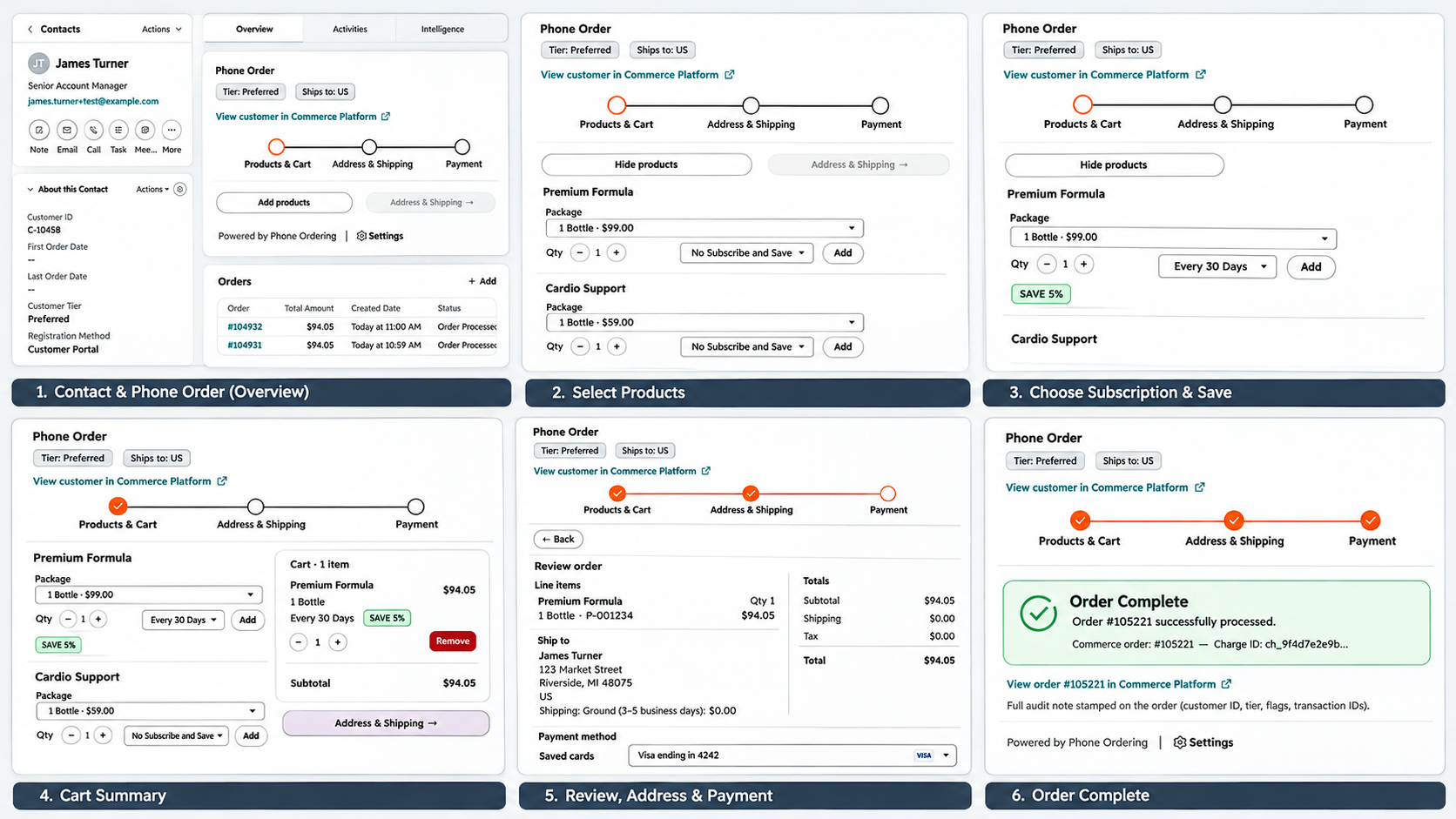
A sales representative taking an order over the phone should not need to understand how a CRM, commerce platform, payment processor, and subscription service exchange data. The representative needs to select products, choose a recurring schedule where appropriate, review the total, and complete the sale.
The desired interface was intentionally modest: one frequency dropdown alongside each eligible product. Select a schedule, and the order reflects the recurring-purchase option. From the representative’s perspective, the process should feel like an ordinary phone order.
The challenge was everything that had to happen after that selection.
The hidden complexity
The workflow crossed five systems: a CRM interface, a custom application, a commerce platform, a payment processor, and a subscription scheduling service. Each system owned a different piece of the transaction. Their identifiers, timing, and failure behavior did not necessarily match.
A recurring-order selection had to survive the journey from the representative’s screen to the completed order and then to a valid future schedule. Meanwhile, a temporary problem in the subscription service could not cause a customer to be charged twice or make the completed order disappear.
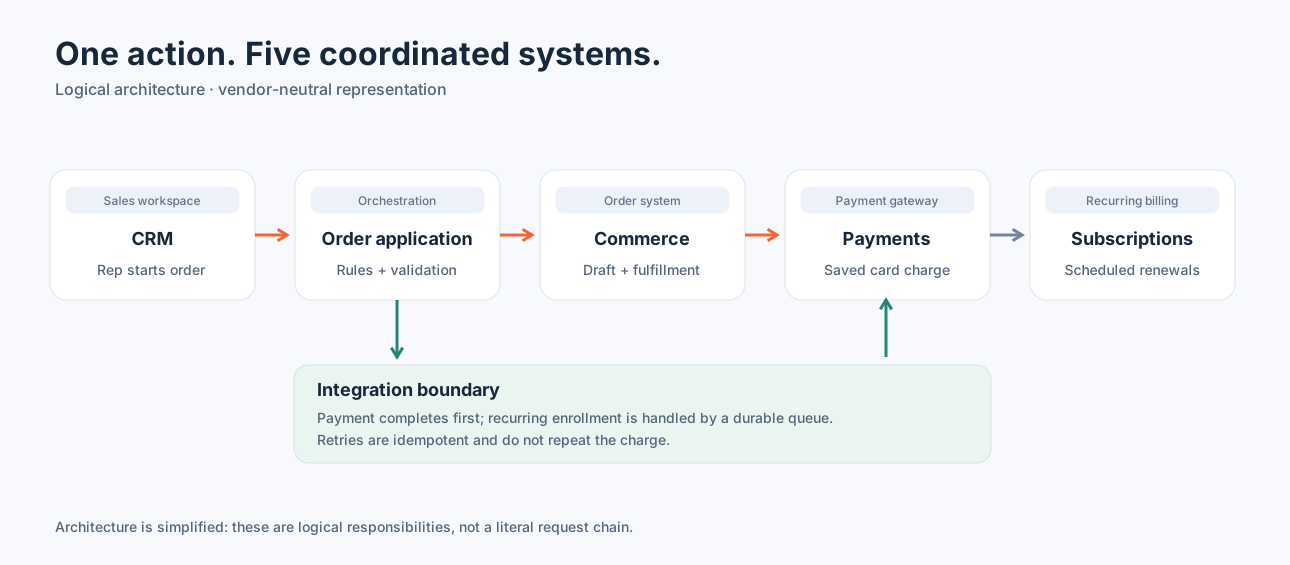
The engineering problem was not simply to make five APIs communicate. It was to define which system was authoritative at each step, what constituted success, and how to recover when a later step failed.
The solution: charge now, enroll safely afterward
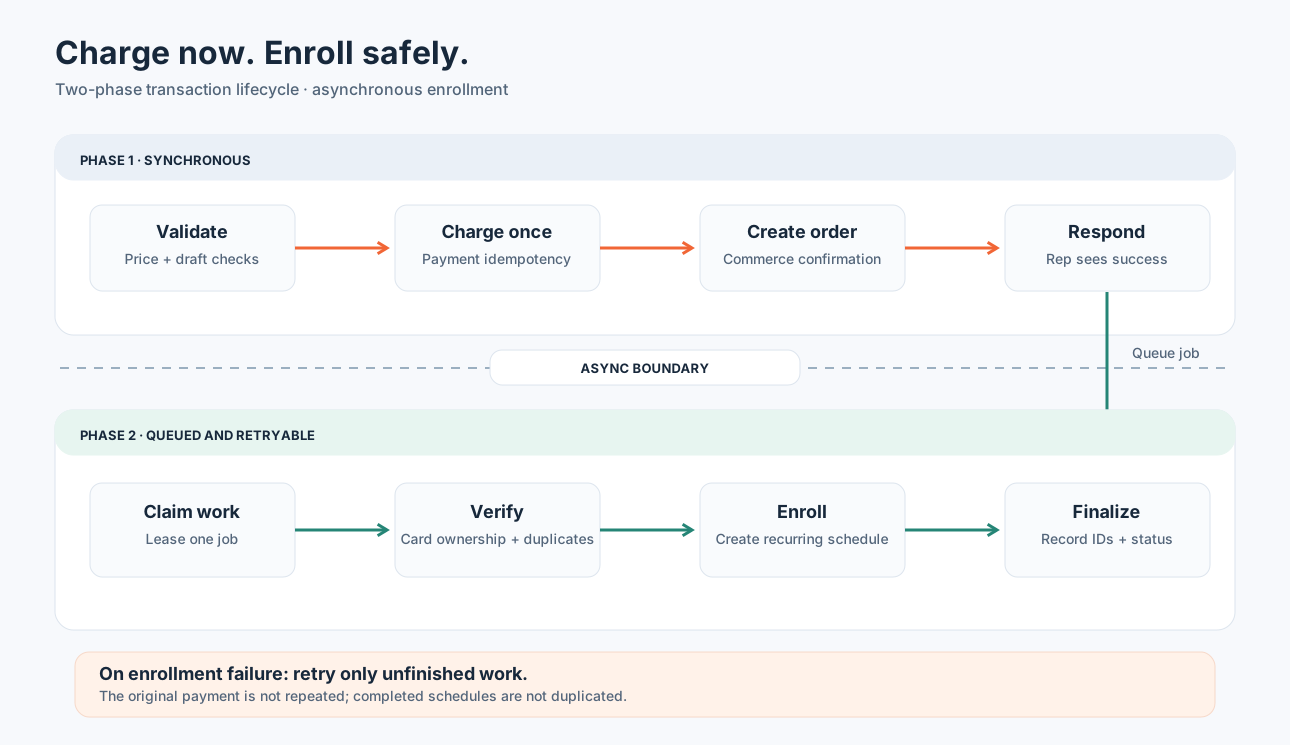
We designed the workflow in two phases.
First, the representative completes the order. The server determines eligible pricing rather than trusting values calculated in the browser. Before charging, the application checks whether the underlying commerce draft has changed. The payment is processed, and the commerce order is completed.
Second, the application records the subscription-enrollment work in a queue. A background worker handles the subscription service separately. The representative does not need to wait for that external system to respond before receiving confirmation that the order was placed.
That separation matters. A subscription provider might be slow, temporarily unavailable, or reject a request because of a format mismatch. None of those conditions should turn a completed customer payment into an ambiguous checkout experience.
Reliability is a feature customers never see
A background queue is only useful if retrying work is safe. We built checks around the operations that could otherwise cause real harm:
- No duplicate enrollments. Before creating a schedule, the worker checks whether one already exists for the originating order.
- Verified payment ownership. The integration verifies the relationship between a stored payment method and its customer before associating it with the subscription system.
- Partial progress is preserved. If one part succeeds and another fails, the next attempt continues from the unfinished work instead of repeating everything.
- Only one worker claims an order at a time. Lease-based processing reduces the risk of competing workers acting on the same enrollment.
- Operators can recover failures. Administrative tools support retrying failed work and rebuilding enrollment tasks when necessary.
These safeguards are less visible than a polished dropdown, but they are what make the dropdown suitable for production.
When integrations disagree with their documentation
The final stretch of the project involved diagnosing differences between what external APIs appeared to expect and what they actually accepted.
One important failure came down to an identifier. The commerce platform represented a product variant using a globally qualified identifier, while the subscription service expected a plain numeric value. Both referred to the same product, but the subscription API rejected the longer format.
The resolution required more than trimming a string in one place. We normalized the identifier at the system boundary, validated its format before submission, and ensured that already queued work could recover on a later retry.
We also improved diagnostic logging so upstream validation errors could be investigated without exposing payment credentials or tokens. In cross-platform engineering, observability is part of reliability: an error that cannot be understood is an error that cannot be fixed confidently.
From implementation to production proof
The work was planned, implemented, debugged, and verified over three days, with 14 merged pull requests. AI coding tools accelerated implementation, but architecture, safety constraints, testing decisions, and production verification remained engineer-directed.
The important result was not the number of lines of code or the speed alone. End-to-end production tests confirmed that fresh phone orders could create recurring schedules, previously stalled enrollments could recover, and test subscription cycles could charge through the payment provider and generate subsequent commerce orders.
The business outcome
For the sales representative, the result is a straightforward ordering experience: select a recurring frequency, complete the sale, and move on to the next customer.
For the business, the result is more substantial: a coordinated workflow that preserves pricing rules, separates customer payments from downstream scheduling, and provides a path to recover from external-system failures without requiring the representative to repeat the transaction.
The best enterprise integrations make complicated systems feel simple without pretending the complexity isn’t there. That is the engineering work behind one dropdown.
Phillips Web Development Company (Phillips WDC) designs and engineers the integrations, internal tools, and business-critical systems that connect modern operations.